
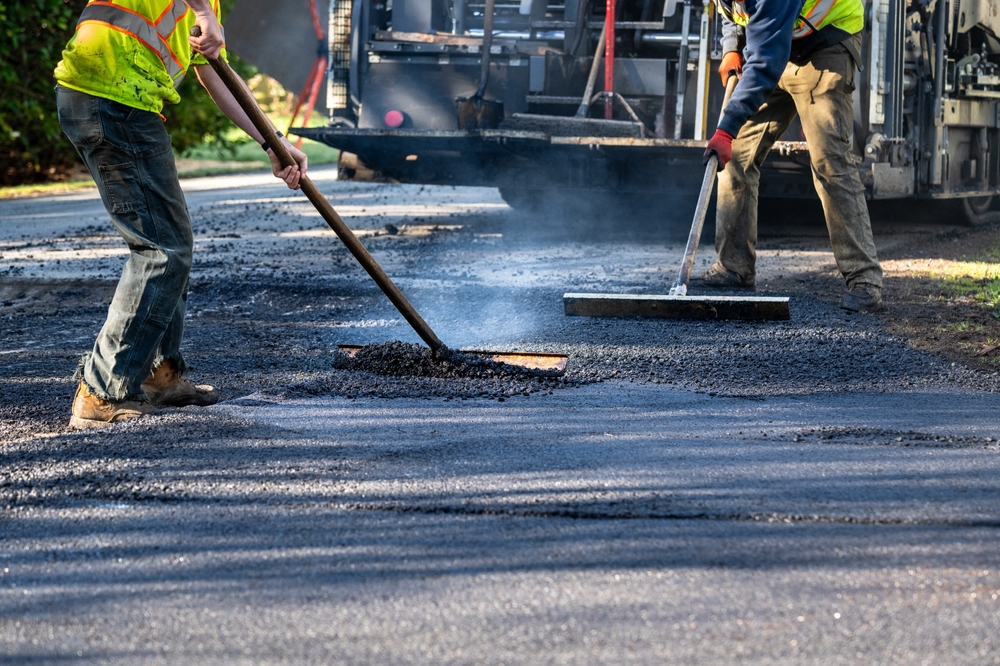
Maryland Humidity & Your Pavement: How Moisture in the Air Affects Curing Times and Why “Dry Days” are Essential for a Perfect Finish
If you have ever watched a freshly paved driveway or parking lot in Maryland and wondered why it seemed to take longer to set than expected, the answer is almost certainly in the air. Literally. Maryland’s climate is notoriously humid, and that invisible moisture hanging over every summer afternoon has a direct and measurable impact on asphalt paving projects across the state. Understanding how humidity affects the curing process can save homeowners and property managers thousands of dollars in repairs and help ensure that any investment in asphalt paving pays off for decades to come.
How Humidity Interferes With the Asphalt Paving Curing Process
When asphalt paving is laid, the mix arrives hot, typically between 275 and 300 degrees Fahrenheit. As it cools, the binder that holds the aggregate together begins to stiffen and harden, a process commonly called curing. This is not simply a matter of temperature dropping. The surface must also shed heat and moisture in a balanced way. When humidity levels are high, as they frequently are throughout Maryland from late spring through early fall, the surrounding air is already saturated with water vapor. This slows the rate at which the asphalt surface releases its own internal heat and moisture.
The result is a longer curing window, a softer surface for a greater period of time, and a higher risk of tracking, indentations, and surface damage during that vulnerable phase. In extreme cases, trapped moisture beneath the mat can compromise the bond between layers, leading to delamination or premature cracking. Skilled contractors who specialize in asphalt paving in Maryland account for these variables before a single shovelful of mix is loaded onto a truck.
What Maryland’s Climate Data Actually Tells Us
Maryland sits in a geographic zone that combines mid-Atlantic coastal influence with the heat of the southern states. Average relative humidity in the Baltimore and Annapolis areas regularly climbs above 70 percent during summer months, and can push toward 90 percent or higher during overnight hours and rain events. Even on days that feel sunny and clear, ground-level humidity can remain elevated for hours after a storm or even after a heavy dew.
This matters enormously for asphalt paving scheduling. A contractor working in Bethesda or Annapolis must evaluate not just the forecast temperature but also the dew point, the relative humidity trend throughout the day, and whether recent rainfall has saturated the subbase. A project that looks viable at 9 in the morning can become problematic by early afternoon if an approaching storm front raises humidity ahead of it. The best contractors in the state build this kind of meteorological awareness into their project planning as a standard practice, not an afterthought.
Why “Dry Days” Are Non-Negotiable for Quality Asphalt Paving
The phrase “dry days” in the context of asphalt paving refers to days when humidity is low, no rain is in the forecast for at least 24 hours, and temperatures are within the acceptable range for compaction and curing. In Maryland, these windows can be surprisingly narrow. Early fall, particularly September into early October, often offers the best combination of moderate temperatures and lower humidity, making it a prime season for asphalt paving projects.
Attempting to pave on a high-humidity day is not just a quality issue; it is a liability issue. If moisture gets into the mix during application, or if the subbase is even slightly damp from a rain event 24 to 48 hours prior, the entire project can fail prematurely. Edges may crumble, the center of the mat may remain soft longer than expected, and the final compaction pass may not achieve the density required for long-term durability. Reputable asphalt paving companies in Maryland will delay a project before they risk a substandard installation, and that approach should be seen as a sign of professionalism rather than inconvenience.
The Role of Temperature and Humidity Working Together
Temperature and humidity do not operate independently when it comes to asphalt paving. They interact in ways that compound the challenge. Hot, humid days create a specific problem: the heat keeps the asphalt workable for longer, which sounds like an advantage, but the humidity slows evaporative cooling at the surface. This combination can make it difficult to achieve proper compaction because the mat stays too pliable for too long.
Conversely, a cool day with low humidity can cause the asphalt to cool too quickly, making compaction difficult for the opposite reason. In Maryland, contractors must navigate both extremes depending on the season. Summer projects face the heat and humidity combination. Spring and fall projects face rapid temperature swings. This is why experienced local contractors are so valuable. They understand that a one-size-fits-all approach to asphalt paving does not work in a state where the weather can shift dramatically within a single workday.
How to Protect Your Investment Before and After Paving
Understanding humidity’s role in asphalt paving is not just useful for contractors; it is equally relevant for property owners. If you are scheduling a driveway replacement or parking lot resurfacing project, work with your contractor to choose a window of dry weather and monitor the forecast closely in the week before installation. Ask your contractor what relative humidity threshold they use to make go or no-go decisions. A threshold of 50 to 60 percent relative humidity is a reasonable benchmark, though highly experienced crews may work confidently in slightly higher conditions depending on temperature and project scope.
After the project is complete, give the surface adequate time to cure before returning vehicles or heavy equipment to it. In low humidity conditions, this might be 24 to 48 hours. In Maryland’s summer humidity, it can be closer to 72 hours or more before the surface is truly ready for normal traffic loads. Applying a quality sealcoat at the appropriate time, typically 90 days to 12 months after installation depending on the product and conditions, adds another layer of moisture protection that extends the life of the pavement significantly.
Conclusion
Maryland’s humidity is not going anywhere, and neither is the need for well-installed, durable pavement. The relationship between atmospheric moisture and asphalt paving outcomes is well established, and the contractors who succeed in this state are the ones who treat weather conditions as a core part of their craft. Choosing dry days, understanding how humidity slows curing, and giving your new surface the time it needs to reach full strength are not optional considerations. They are the foundation of any asphalt paving project that is meant to last. When you partner with a contractor who takes these factors seriously, you are not just getting a paved surface. You are getting a surface that was built to handle everything Maryland’s climate has in store.
Need a Paving Contractor Near You?
Established in 2014, Maryland Asphalt LLC has been providing high-quality asphalt and paving services to the areas of Montgomery and Frederick Counties and the surrounding areas. Family owned and operated, we offer quality services at competitive prices. We specialize in commercial and residential asphalt paving and our asphalt services including parking lot maintenance, parking lot repair, commercial driveways, residential driveways, public and private roads, resurfacing, seal-coating and more! Don’t settle for less. The cost of doing it over is more than the cost of doing it right the first time. If you need an expert paver you can trust, call us today.
Categorised in: Asphalt Paving